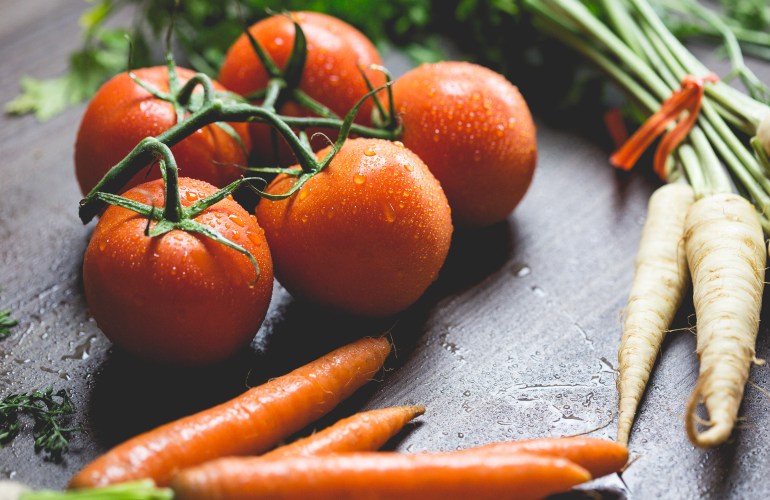
I love food and I love cooking. In fact, I think it’s my love of food that first introduced me to the world of sustainability by way of the local food movement. Food is a big topic, so I expect to write several posts on the subject. But I wanted to start with what I think is the most basic advice you could give to someone who is trying to eat healthier and more sustainably – learn to cook.
A pretty standard rule of thumb when it comes to trying to eat healthier is to eat foods with minimal processing. An imperfect, but simple, tip I’ve heard a lot is to shop around the perimeter of the grocery store and spend little time in the center aisles. This is because processed foods tend to be packed with sugar, fats and sodium and many processed foods offer little nutritional benefit.
One of the most direct parallels between personal health and sustainability is that less processed foods tend to be more sustainable as well. Less energy has to go into transport and processing and packaging. Not to mention that you have to account for the transport, processing, packaging of multiple ingredients. Which means that an apple is likely to have a much smaller carbon footprint than applesauce. And if you can get it locally, then the footprint is even smaller still.
So it’s a no brainer that both nutritionists and sustainability advocates encourage people to buy less processed foods, but in the process they tend to make the assumption that people want to cook, know how to cook and have the time and equipment needed to cook. The first two are relatively easy to address; the third is more complicated, but here are my thoughts on each.
Why should you want to cook?
- Your health. I’ve already outlined the health benefits of working with less processed foods, but basically by cooking yourself you can control the amount of fat, sugar and salt you consume, and you’ll be working with and eating more nutritionally dense food.
- Gain a greater appreciation for food. Cooking allows you to learn more about different ingredients and can encourage you to try new things. Plus, working with whole produce that is as close as possible to how it came out of the ground helps you gain an appreciation for the varied bounty of nature. I love thinking about how there are so many plants in the world that are not only beautiful, but also delicious and nutritious.
- It’s creative. By creative, I don’t necessarily mean innovative. I mean it in the sense of actually making something as opposed to just consuming. So much emphasis is put on the innovative connotation of the word “creative” in our society that I don’t think people appreciate how important it is to just make things in general, even if that just means following a recipe to the T. Cooking is not only a useful skill to learn, but the act of cooking stimulates all of your senses and gets your brain working in new ways.
- It’s social. Everyone loves food, and if you can make good food–even just so-so food–your friends and family are going to love it.
What if you don’t know how?
- Take a class. Self-explanatory
- Ask a friend/ family member. Chances are that there is someone in your extended family who is a good cook, or at least knows how to cook one thing well. Ask them to teach you how to cook it.
- Online videos. If a class is too expensive and you hate all your relatives’ cooking, then do your own research. There is so much on the internet. I would suggest watching videos over simply reading recipes, and I’d suggest instructional videos, like this one for example, over something like Food Network.
- Meal kits. Meal kits like Hello Fresh, Blue Apron, Sunbasket, Purple Carrot, etc. have become popular in recent years. I haven’t worked with them much, but I’ve had friends who’ve said that meal kits really helped them learn how to cook and try new things.
- Olive oil, salt and pepper. Finally, a general rule of thumb. Pretty much anything is delicious if you toss it in olive oil, salt, and pepper and then roast, sautee or (in some cases) eat it raw.
What if you don’t have the time?
- You don’t have to cook every night. I understand that you may have a busy life that doesn’t allow you to cook a full meal every night. But can you cook one night a week? That’s better than nothing.
- Buy pre-cut, frozen and canned. More and more grocery stores are selling pre-chopped produce. Use it! And there’s also no shame in buying frozen or canned. Yes, it is more processed, and you have to watch out for any sauces that may be added, but it’s still less processed than a lot of the stuff in the grocery store. Some things, like beans, are also better canned than making it yourself. (This is why I think the tip to only shop around the perimeter of the grocery store is imperfect).
- Meal prep. I wouldn’t suggest this if you’re a complete cooking novice, but prepping a bunch of meals at the beginning of the week is a great way to work more home cooked meals into your diet throughout your busy week.
What about equipment?
This is a question I think is ignored a lot when people encourage eating less processed foods because it’s easy to assume that everyone has access to kitchen equipment, but a lot of people don’t and we need to acknowledge that.
- You can cook a lot of stuff in a microwave. Microwaves can sometimes be treated like the redheaded stepchild of the kitchen, but you can cook a lot of things other than hot pockets, pizza rolls and frozen burritos in a microwave.
- It doesn’t have to be perfect. Yeah, super sharp knives and unwarped pans are going to make it easier to get consistent results, but you can still cook plenty of things with whatever equipment you have, even if it’s just something you got at Goodwill.
- Buy pre-cut, frozen and canned. I’ll say it again because this not only saves time, but if you don’t have knives or a cutting board to chop vegetables, just buy pre-cut.
I know I’m biased because I’ve always loved cooking. But I do believe it’s an incredibly valuable skill to develop for so many reasons. Home cooked food is generally healthier, more nutritious and better for the planet, and it gets you thinking about food in a creative way rather than just something to consume. Yet, I know there are plenty of people out there who don’t like to cook, or whose lifestyle doesn’t really allow it. So I’m not saying that you have to cook every night. But I do ask you to learn to cook something, anything.
 Flourishing