
How you spend your time is how you spend your life. It’s as simple as that.
Although that may seem obvious, ask yourself if you’re actually living your life in a way that recognizes that. Do you even really think about how you spend your time? Or do you just fall into unthinking patterns of behavior (a.k.a. habits).
Taking responsibility for how I spend my time was necessary for taking control of my own path to flourishing. As I mentioned in “Go Boldly,” up to a certain point in my life I was more or less just following what others had done. I had to take action toward my desires to live a happier, more fulfilling life. But a single action is not enough. You have to follow through and stick with it. And that’s the hard part.
It’s no secret that change is hard. As I mentioned in my post on Visioning, there are a lot of factors that influence our actions and beliefs, and not all of them are in our best interests. And a lot of our behavior is the result of habits, the kind of “system 1” thinking I mentioned in “Money Matters.” But even though habits are hard to break, it is possible to shift your habits so that they are more in line with what you want in life and in the world.
So how do you do that? Well, first you need to figure out what you want to put your energy toward. Visioning can help with this. Another useful tool is to simply identify something in your life that you’re dissatisfied with. Maybe you want to lose weight, or you feel lonely, or you want to help with something in your community. It could be anything. Just figure out one thing to focus on at first, commit to spending time each week working toward making it better and then make it part of your schedule.
I know some of you probably recoiled at the word “schedule.” You may not like the idea of being a “slave” to one. But the thing is, that we all have schedules whether we like it or not. We all make choices about how to spend our time, and if you want to shift from unconscious choices controlled by outside factors to conscious choices driven by what you value and want, then you need to examine your schedule and see it as your friend. You don’t have to schedule every moment of every day. I’m a big believer in allowing yourself time to just veg out or do whatever you feel like. But you need to schedule enough so that you’re not spending all of your free time in front of the TV, staring at social media or doing something else that doesn’t really contribute to your happiness.
Sticking to a schedule is also helpful for building habits and the kind of lasting lifestyle changes that should be your goal. So, don’t just make a schedule. Stick to it.
Making a schedule will help you realize how much free time you really have. A few years ago I was working full time, in grad school, worked part time with a farmers market, and had a relationship and a dog to take care of. Although that was a lot, it was manageable, and I was even able to exercise, get at least 8 hours of sleep and have at least 2 free nights a week. Here’s a rough illustration of what a weekly schedule looked like during that time:
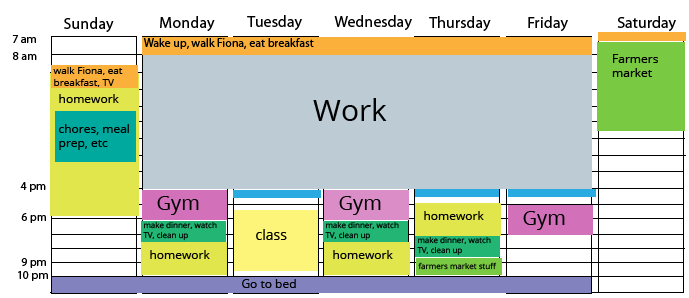
Drawing out a week’s schedule really helped me realize how much free time I had. And an important thing to know is that even though it was structured, I allowed myself free time and flexibility. Sundays were generally pretty flexible, I wouldn’t set an alarm (since it was my only day to sleep in) and I’d take my time waking up, generally making a nicer breakfast and watching TV with Steve before starting homework. And then I’d do an hour or two of reading and then take a break to meal prep, clean, or eat lunch with Steve, then back to homework for a couple more hours then another break. And some weeks I’d do homework on Saturday so that Steve and I could have all Sunday together.
I encourage you to draw out your own schedule to examine how you spend your time. Granted, you may have less time than I did. I don’t have kids, and I also worked from home with a job that didn’t have any commitments outside of office hours, and I have a partner that helps out with housework. But if you draw up a schedule and block out your commitments, I’m pretty sure you’ll find that you have more free time than you think. Sure, you need some of that free time to recharge, but even just finding a couple of hours a week to put toward improvement will help you flourish.
You also may have opportunities to make better use of your existing commitments. Have an hour-long commute? Use that time to listen to audiobooks or podcasts about a subject you’re interested in. Spending time with your faith community important to you? Join or create groups within your church/synagogue/whatever that focus on something else you care about like music, exercise, charity, etc. Need a job to pay the bills? Research how you can translate your skills into a job or career that also contributes to something you care about (and then go for one of those jobs).
Finally, some of you may hate the idea of scheduling because you may not “feel like” exercising, or reading, or practicing at the time you have scheduled for the activity. To that I say maybe you just don’t want to do that thing. You may think that you want to be a great musician, but if you’re not willing to practice even when you don’t feel like it, then you’re not going to be, which is ok. Maybe you’re happier just being an average musician who picks up the instrument every once in a while, and you’d be better served by spending your time working toward something else. It’s up to you to figure out what.
We may not be able to control how we spend all of our time, but we can make the best use of the control we do have. Structure your time into a schedule that reflects what is important to you. Then follow that schedule to help you build habits that lead to flourishing.
 Flourishing